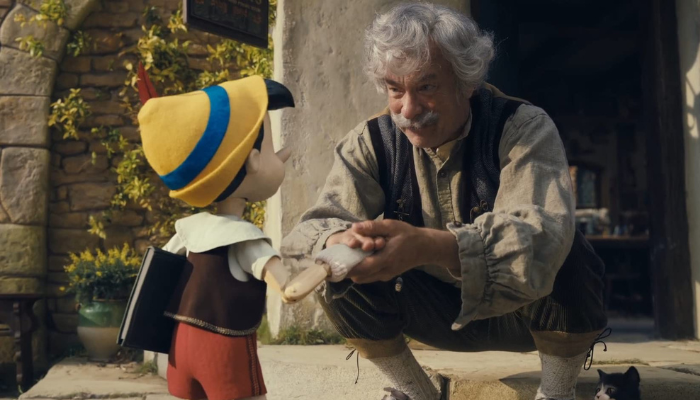
This isn’t your childhood’s Pinocchio. Guillermo del Toro’s take (co-directed with Mark Gustafson) reimagines the wooden boy tale under the shadow of war, loss, and loyalty. It’s stop-motion, it’s musical, it’s dark, but it’s also deeply loving. Del Toro uses this classic fairy tale to explore what it means to be human, to make mistakes, and to learn what love and fatherhood truly cost. The film is both awe-inspiring and somber, a fairytale for grownups who haven’t forgotten how to believe.
Read also: Turning Red – Animated Movie Review
The story begins in Italy during World War I. Geppetto, a woodcarver, is mourning the death of his son Carlo, lost in an aerial bombardment. In grief, he plants a pine tree over Carlo’s grave. Years later, in drunken despair, he carves a puppet from the wood of that pine tree. These origins already set a darker tone: the creation of Pinocchio is born from longing, guilt, and the desperate hope to bring back what was lost.
Read also: Frankenstein – A Netflix Hollywood Review
Late at night, the Wood Sprite visits Geppetto, bringing the puppet to life. The creature that becomes Pinocchio is given moral guidance by Sebastian J. Cricket, once trapped inside the pine tree, and tasked with proving himself worthy of a wish: the wish being tied to whether he can be more than a wooden puppet, whether loyalty, love, selflessness can outshine forbidden pleasures.
Pinocchio’s journey is far from easy. He lacks impulse control, which leads to chaos. Geppetto is initially frightened, then frustrated. Pinocchio is sent to school (with Carlo’s old schoolbook), but before long, mischievous showman Count Volpe and his monkey Spazzatura entangle him in a circus life, luring him away from home with promises of purpose and entertainment. Pinocchio signs a contract and performs; there are high points and absurdities, but also danger.
Read also: SENIOR YEAR (NETFLIX REVIEW) 2022
Pinocchio is drafted by the Podestà (a fascist official) into a boys’ military training camp. There he meets Candlewick, a boy scared of his powerful father and compelled to prove himself. The camp represents moral and physical danger: Pinocchio must decide between obeying authority and following his conscience, between survival and doing what he believes to be right. The interaction with Candlewick becomes meaningful, as both of them navigate identity, courage, and fear of rejection.


Violent forces, war, bombings, and death loom: the film doesn’t shy away from tragedy. At several points Pinocchio dies, only to be revived. Death is a recurring element: the idea that life can be lost, regained, and that immortality might carry its own weight of sorrow. The film builds to a point where Pinocchio must sacrifice himself to save others, specifically Geppetto even if it means risking that renewal.
Read also: BABY FARM (NETFLIX REVIEW) 2025
Through a series of trials, including rescue from a sea creature (the Dogfish), betrayal, loss, and performance under propaganda, Pinocchio eventually demonstrates not just obedience, but love, sacrifice, and loyalty. The resolution doesn’t feel fairy-tale perfect: it carries scars. Geppetto has to reckon with loss, Pinocchio with what it means to be real. The final message isn’t just “be good” but: humanity is messy. Being a real boy isn’t about perfection; it’s about love, responsibility, and choosing who you want to be even when it hurts.
Read also: SLEEP OVER (NETFLIX REVIEW) 2020
Directors: Guillermo del Toro & Mark Gustafson
Cast: Gregory Mann as Pinocchio, Ewan McGregor as Sebastian J. Cricket, David Bradley as Geppetto, Cate Blanchett, Finn Wolfhard, Tilda Swinton, Ron Perlman, Christoph Waltz in supporting roles
Runtime: 121 minutes
Watch trailer here